
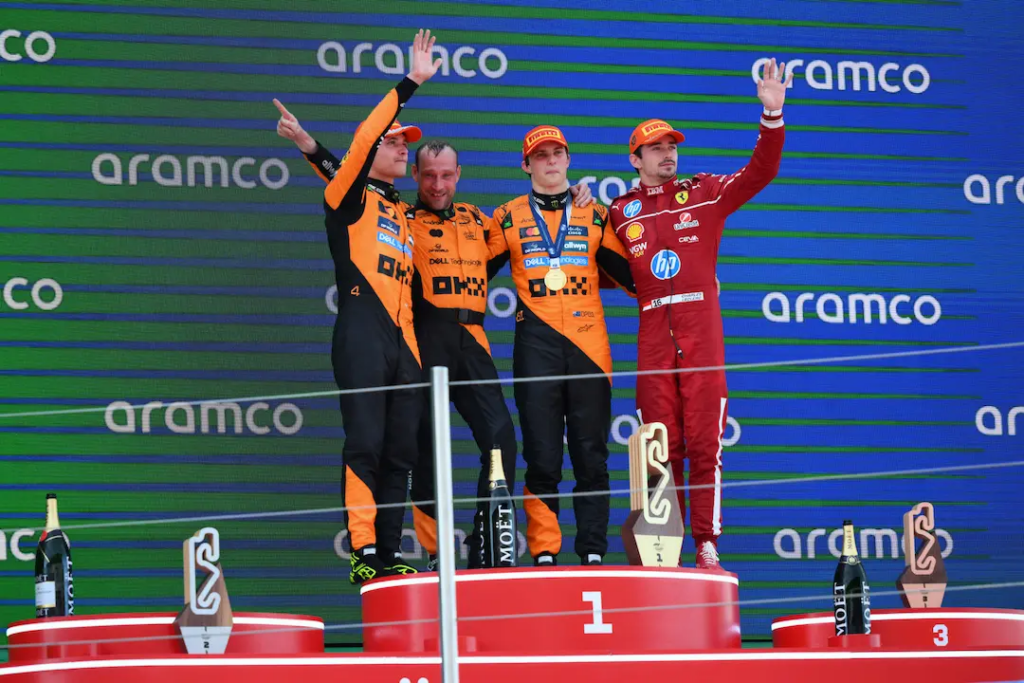
There are results, and then there are moments. The 2026 Barcelona-Catalunya Grand Prix produced both, but the result will fade from memory long before the moment does. Lewis Hamilton took a momentous first race victory in red with Ferrari at the Circuit de Barcelona-Catalunya on Sunday, with George Russell crossing the line in second and defending champion Lando Norris completing the podium in third: making it an all-British top three for the first time since 1968.
Fifty-eight years. That is the gap between what happened on Sunday in Spain and the last time
three British drivers stood together on an F1 podium. The sport, for all its technical evolution
and global expansion, had not managed to produce that image in over half a century.
Barcelona 2026 delivered it, and did so with a narrative arc that felt almost scripted.
The Weight of 58 Years
The last all-British F1 podium occurred at the 1968 US Grand Prix at Watkins Glen, where
Jackie Stewart won, with World Champion Graham Hill in second and John Surtees completing
the top three.
That was a different era of the sport: more dangerous, less global, and defined by a tight
group of British drivers who dominated the grid. What made Sunday’s podium particularly
striking is the echo it carries. It was also the first time any single nation had placed three drivers
in the top three since France’s Patrick Tambay, Alain Prost and René Arnoux swept the podium
at the 1983 San Marino Grand Prix.
A 43-year wait for that feat. And now, on the same afternoon, both records fell.
That is not a coincidence. It is a reflection of what British motorsport has quietly built over the
past decade: a generational cohort of talent that has arrived at the same elite level at the
same time, in a sport where even two British podium finishers in a single race is considered
exceptional.
Hamilton at 41: A Victory That Rewrites Several Records
The headline number is 106. Lewis Hamilton ultimately crossed the line 19.5 seconds ahead of Russell to claim his first Grand Prix win for Ferrari and his 106th career victory overall. But that number alone does not capture what Sunday meant. Hamilton drove superbly in a high tyre wear race to take his first Grand Prix victory since his last triumph for Mercedes in July 2024, at 41 years old: becoming the seventh oldest race winner in F1 history. It also made him the oldest race winner since Jack Brabham in 1970, who was 43 years and 11 months at his final win in South Africa.
The move to Ferrari was always going to be framed through results. A difficult adaptation period,
questions about timing, questions about relevance: the sport had been patient, but the
conversation was beginning to shift. Barcelona answered it with authority. This win signals that Ferrari could now be a genuine challenge for Mercedes if they can get both cars on equal technical terms.
One race does not confirm a trend, but the manner of this victory (strategic, composed, built on precision rather than fortune) was exactly the kind of statement Hamilton needed to make. It was Ferrari’s first victory since Carlos Sainz won the 2024 Mexican Grand Prix. A drought of that length for a constructor of that stature carries its own pressure. Sunday it was released.
Ferrari’s Strategic Masterstroke
The win did not arrive on pace alone. Ferrari gambled on a three-stop strategy which played out flawlessly, as Hamilton gained a free pit stop under a Virtual Safety Car triggered by Fernando Alonso’s retirement on lap 40. George Russell had taken pole position by just 0.064 seconds: edging Hamilton in qualifying and doing so in a session that ended Kimi Antonelli’s run of five consecutive poles to start the
2026 season.
The grid order suggested a Mercedes race. What unfolded was a Ferrari masterclass in strategic execution. The VSC window, the kind of margin that defines seasons, arrived precisely when Ferrari
needed it. They took it. From that point, Hamilton delivered a series of stunning laps to gradually increase his advantage over the Silver Arrows. Russell held his position and drove a clean, controlled race to take second. But on Sunday, Ferrari out-thought Mercedes in the strategic battle that ultimately mattered most.
Antonelli’s Championship Lead Survives, But the Picture Has Changed
Kimi Antonelli arrived in Barcelona as the dominant force of the 2026 season. He left it differently. Antonelli suffered a major retirement in the closing stages, losing what had briefly become a P2
position and failing to score points on a day when both of his title rivals finished on the podium.
His championship lead over Hamilton was slashed from 66 points to 41 as a result.
The lead remains substantial, and Antonelli’s form across the first portion of the season has been
exceptional. But the gap is no longer comfortable. Ferrari has found something. Hamilton has
found something. And the remainder of the 2026 calendar now looks considerably more open
than it did 24 hours ago.
For a 19-year-old in his first full season carrying championship expectations, the retirement will
be a formative moment. How he processes and responds to it will define the shape of this title
fight more than any single result since it began.
Russell: The Steady Hand at the Front
George Russell’s performance at Barcelona deserves more attention than it is likely to receive.
He took pole position in a session where the two most talked-about drivers in the paddock were
fighting for the front row. He held the lead in the opening stages of the race. He finished second
only losing position to the combination of Hamilton’s strategy and circumstances that were
largely outside his control.
Russell came into Barcelona with a point to prove after a P12 finish in Monaco had cost him
second place in the drivers’ standings to Hamilton. He did not get the victory, but he reasserted
himself as a consistent front-runner and added a strong haul of points in a race that turned
messy for several of the drivers around him.
In a season where the championship narrative has centred on Antonelli and Hamilton, Russell is
building quietly and consistently. That rarely makes headlines. It does, however, win
championships.
Norris: The Defending Champion Completes the Picture
Lando Norris’s third place was framed in pre-race coverage as a recovery from a difficult
weekend for McLaren. It is worth being precise about what that actually means. Norris closed to within two points of Charles Leclerc in the championship standings, and did so on a weekend where his own car was not performing at the level McLaren demanded.
That kind of damage limitation, executed without drama and without complaint, is the hallmark of a
defending champion who understands the mathematics of long seasons. He did not win in Barcelona. But he was present, he was composed, and when the moment came to make the podium historic, he was exactly where he needed to be.
What British Motorsport Has Built
The easy narrative is to call Sunday’s podium a happy coincidence: three British drivers who happened to be quick enough at the same venue, on the same afternoon. The accurate narrative is more deliberate than that. Hamilton, Russell and Norris represent three distinct generations and three distinct pathways
through the sport, all arriving at the highest level simultaneously. Hamilton is the sport’s all-time
record holder, operating on borrowed time only in the sense that all elite careers are finite.
Russell is in the prime window of a career that has been managed and developed with
considerable intelligence. Norris is the defending champion at 26, with the title already on his
mantelpiece and the best years of his career still ahead.
The 1968 British trio (Stewart, Hill and Surtees) were all world champions. The 2026 edition
carries its own version of that distinction. The podium was not accidental. It was earned by three
drivers operating at the top of a sport where finishing in the top three requires everything to be
right at once.
The Championship Picture Heading to Austria
Max Verstappen finished fourth and Oscar Piastri fifth, with both drivers losing ground on the
front-runners despite completing the race on the lead lap. Charles Leclerc also retired late in the
race, compounding a difficult afternoon for several of the pre-season championship contenders.
The Austrian Grand Prix at the Red Bull Ring follows in two weeks. Historically, that circuit has
suited Red Bull. Whether the momentum created by Hamilton and Ferrari at Barcelona carries
forward, or whether Antonelli and Mercedes reassert control, will shape the entire second half of
the season.
The championship has changed shape. Not dramatically, not definitively, but undeniably.
The Abu Dhabi Dimension
For those watching from the UAE, Sunday’s race carried its own kind of significance.
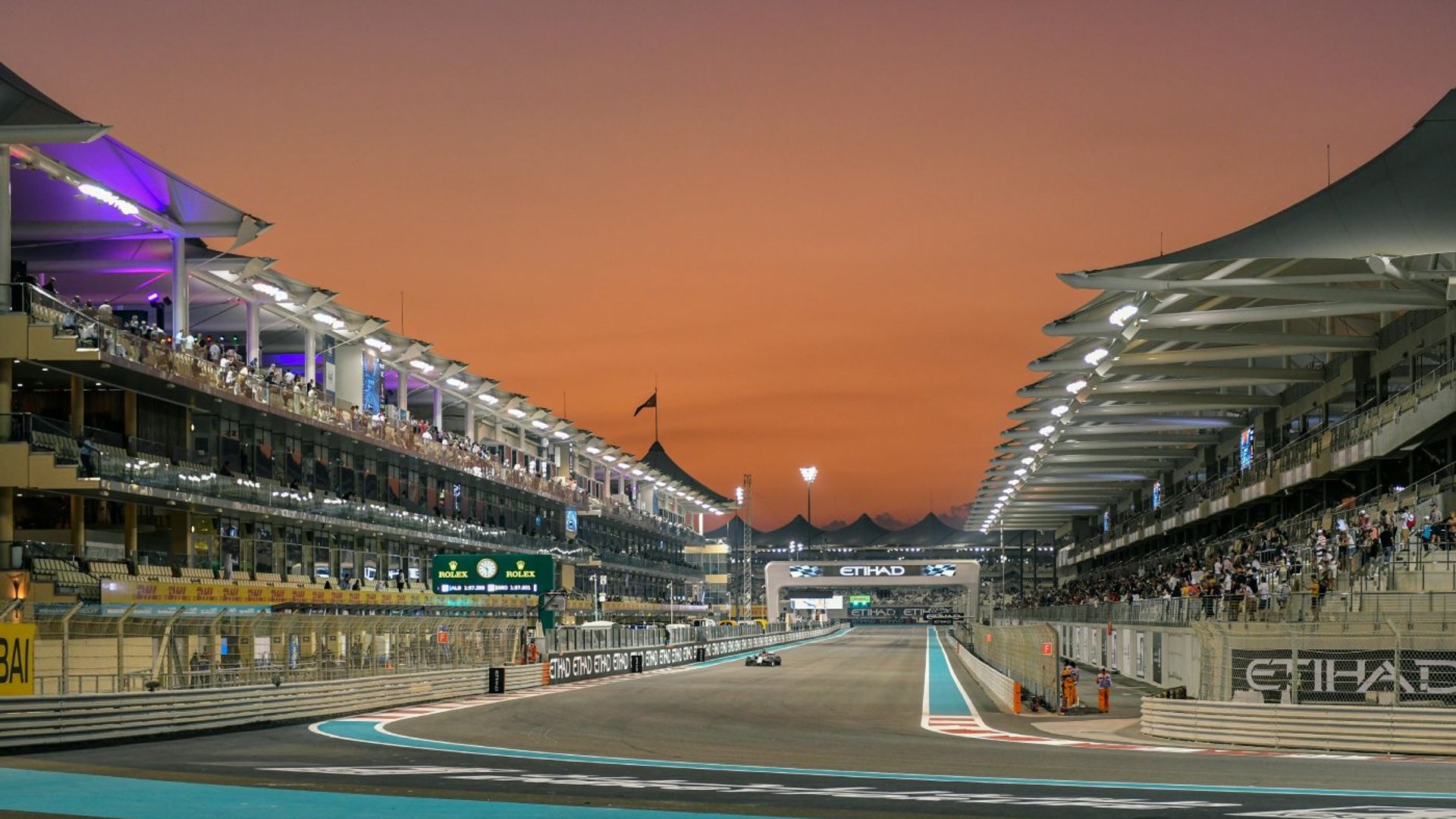
The F1 Abu Dhabi Grand Prix at Yas Marina Circuit has been the season finale for over a
decade: the race that closes world championships and ends careers, a circuit where the
Theatrical weight of the sport tends to arrive fully formed. What Barcelona confirmed is that the
The 2026 championship story is far from resolved by the time the paddock reaches Abu Dhabi in
November.
If anything, Sunday’s result suggests that this season’s finale could carry the kind of tension the Yas Marina Circuit does justice to better than almost any venue on the calendar. Multi-team competition at the front. A compressed championship. Three British drivers who have demonstrated they are all capable of winning. A 19-year-old who will have spent the second half of the season defending a lead that is no longer as comfortable as it appeared before Barcelona.
The Abu Dhabi Grand Prix has a habit of producing moments that define entire eras. After Sunday, it looks increasingly likely that 2026 will be no exception.
Final Thought: The Image Matters
Statistics will record Hamilton’s 106th win, Ferrari’s return to victory, and the championship implications of Antonelli’s retirement. But what will last is the image on the podium. Three British drivers, three different teams, three different chapters of the same national story: standing together at the top of the most technically demanding sport on earth, for the first time in 58 years.
The sport produces results every other weekend.
It produces moments like that once in a generation.